Plastic Injection Molding Defects: Causes, Fixes, and Prevention Steps
TIME
Click count
Plastic Injection Molding Defects: Causes, Fixes, and Prevention Steps
Plasticinjectionmolding defects can quietly damage quality, delivery speed, and compliance performance. They rarely begin as one dramatic failure. More often, they start as small process shifts.
A slight temperature drift, uneven cooling, poor venting, or inconsistent material drying can trigger visible flaws. In real production, those flaws quickly turn into scrap, rework, delays, and customer concern.
For operations where reliability matters, plasticinjectionmolding quality is not only a shop-floor issue. It affects project milestones, supplier confidence, audit readiness, and downstream assembly stability.
This guide breaks down the most common plasticinjectionmolding defects, their root causes, practical fixes, and prevention steps. The focus stays on decisions that improve repeatability, not temporary firefighting.
Why Plastic Injection Molding Defects Happen
Most plasticinjectionmolding defects come from interaction, not a single variable. Material, mold, machine, environment, and operator settings influence each other at every cycle.
A part may show sink marks, for example, but the real cause might involve wall thickness, hold pressure, gate location, and cooling time together. Treating only the symptom wastes time.
From a project perspective, defect control improves when teams separate causes into five groups:
- Material issues, such as moisture, contamination, or poor resin selection
- Mold design issues, including venting, gating, and wall imbalance
- Machine setting issues, such as pressure, speed, and melt temperature
- Cooling and cycle issues that change shrinkage behavior
- Control issues, including weak documentation and unstable change management
That structure makes plasticinjectionmolding troubleshooting faster. It also helps cross-functional teams avoid blame-driven discussions and focus on measurable process correction.
The Most Common Plastic Injection Molding Defects
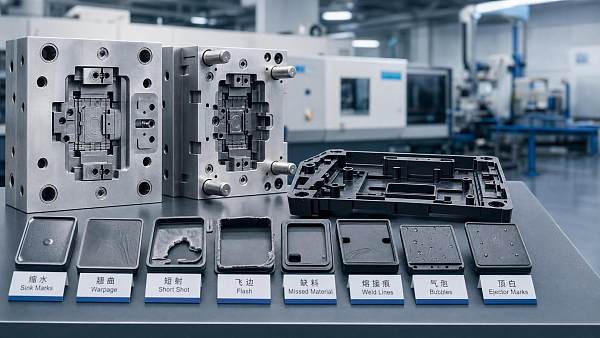
1. Sink Marks
Sink marks appear as shallow depressions, usually near thick sections or ribs. They are one of the most frequent plasticinjectionmolding defects in structural and cosmetic parts.
Common causes include excessive wall thickness, low packing pressure, short hold time, and slow internal cooling. Poor gate sizing can also limit proper material packing.
Useful fixes include increasing hold pressure, extending hold time, improving gate efficiency, and redesigning thick areas. In many cases, rib thickness reduction gives the best long-term result.
2. Warping
Warping happens when a part twists or bends after ejection. It often signals uneven shrinkage across the component.
In plasticinjectionmolding, warping usually comes from non-uniform cooling, inconsistent wall geometry, fiber orientation, or early part removal from the mold.
The best fixes are balancing cooling channels, standardizing wall sections, adjusting mold temperature, and reviewing resin choice. Semi-crystalline materials often need tighter shrinkage control.
3. Short Shots
Short shots occur when the cavity does not fully fill. The result is an incomplete part, often with missing edges or unformed details.
Typical causes include low melt temperature, low injection pressure, restricted gates, trapped air, or insufficient shot size. Thin-wall parts are especially sensitive.
Short-term corrections involve raising fill pressure, increasing melt flow, and checking vents. Long-term plasticinjectionmolding prevention usually requires gate and flow path optimization.
4. Flash
Flash is excess material that escapes along parting lines, ejector areas, or inserts. It creates trimming work and may affect fit, sealing, or safety.
Causes usually include excessive injection pressure, worn mold surfaces, poor clamping force, or resin viscosity that falls too low at processing temperature.
Reducing pressure may help immediately, but recurring flash often points to tooling wear. That is why plasticinjectionmolding defect review should include mold maintenance records.
5. Burn Marks and Splay
Burn marks appear as dark streaks, while splay shows silver-like lines. Both are strong signs that process discipline needs attention.
Burn marks usually come from trapped gas and overheating. Splay often comes from moisture, volatile contamination, or material degradation during plasticinjectionmolding.
Improved venting, lower shear, better drying, and tighter hopper handling are common solutions. More importantly, incoming resin control should not be separated from process control.
A Practical Root-Cause Framework
When plasticinjectionmolding defects appear, reacting too fast can make the process less stable. A structured review reduces trial-and-error changes.
- Confirm the defect pattern by shift, cavity, material lot, and machine
- Separate visual symptoms from process data and dimensional results
- Check recent changes in resin, tooling, maintenance, and parameter settings
- Adjust one variable at a time and record the response
- Lock the corrected window with documented limits and approvals
This approach sounds simple, but it protects production from uncontrolled adjustments. It also gives a stronger evidence trail for customer reviews, PPAP discussions, and internal audits.
Fast Fixes Versus Sustainable Prevention
A common mistake in plasticinjectionmolding is confusing a temporary fix with a reliable solution. Raising pressure may hide a defect today, but it can create stress, flash, or dimensional drift tomorrow.
Sustainable prevention usually depends on process capability, tooling condition, and design alignment. If those three remain disconnected, defect recurrence is likely.
The most effective prevention steps include:
- Dry hygroscopic materials to verified specifications before use
- Standardize startup sheets and approved process windows
- Validate cooling balance across all cavities and critical zones
- Review part geometry for abrupt thickness changes
- Maintain vents, gates, shutoffs, and parting surfaces regularly
- Track defect trends by cavity, tool, shift, and resin lot
In practice, these steps bring more value than repeated emergency adjustments. They lower scrap, protect cycle efficiency, and make plasticinjectionmolding output easier to forecast.
What Project Leaders Should Monitor
Plasticinjectionmolding defects should be tracked as business signals, not only technical events. A rising defect rate often warns of broader planning risk.
More visible scrap is only the first issue. Hidden effects can include unstable lead times, missed validation runs, extra inspection labor, and delayed assembly integration.
Useful indicators include first-pass yield, cavity-specific rejection, process deviation frequency, mold maintenance intervals, and resin moisture compliance. These metrics give early warning before failure costs escalate.
This is especially important in regulated or high-performance sectors. If parts support critical equipment, even small plasticinjectionmolding inconsistencies may affect qualification, traceability, or safety documentation.
Defect Control Checklist for Better Production Stability
Use this checklist to strengthen plasticinjectionmolding control before defects become costly:
- Confirm resin grade, storage condition, and drying record
- Verify machine settings against the approved processing window
- Inspect vents, gates, cooling lines, and shutoff surfaces
- Review wall thickness transitions and gate placement feasibility
- Compare defects by cavity, shift, and operator intervention history
- Document corrective actions with measurable acceptance criteria
- Escalate recurring defects to design or tooling review quickly
The key is consistency. When teams treat plasticinjectionmolding defect management as a controlled system, response speed improves and repeat issues decline.
Final Takeaway
Plasticinjectionmolding defects are rarely random. They usually reflect an underlying gap in material control, tooling condition, parameter discipline, or design compatibility.
The most effective response is not chasing symptoms one by one. It is building a repeatable system that connects root-cause analysis, corrective action, and prevention.
If plasticinjectionmolding quality matters to delivery, compliance, and long-term equipment performance, start with the basics, validate every change, and standardize what works. That is how defect reduction becomes production stability.
Recommended News
 Jul 10, 2026Industrial Structural Adhesives High Strength: When Bonding Beats WeldingIndustrial structural adhesives high strength solutions can outperform welding in critical assemblies. Discover when bonding reduces weight, spreads stress, and improves durability.
 Jun 21, 2026Plastic Injection Molding Defects: Causes, Fixes, and Prevention Stepsplasticinjectionmolding defects explained: discover common causes, practical fixes, and prevention steps to reduce scrap, improve quality, and keep production stable.
 Jun 10, 2026Medical Device Injection Molding: Key Compliance and Material RisksPlastic injection molding for medical devices demands more than precision. Explore key compliance and material risks, from traceability to sterilization, to avoid costly validation setbacks.
![]() Apr 24, 2026Material science factors behind better structural adhesivesMaterial science drives better structural adhesives for industrial engineering, aerospace engineering, and energy infrastructure. Learn how safety protocols, international standards, and regulatory compliance shape reliable performance in extreme environments.
Apr 24, 2026Material science factors behind better structural adhesivesMaterial science drives better structural adhesives for industrial engineering, aerospace engineering, and energy infrastructure. Learn how safety protocols, international standards, and regulatory compliance shape reliable performance in extreme environments.

All Categories
Hot Articles
- How to select hazardous area protection for offshore oil and gas sitesSep 12, 2026Hazardous area protection oil and gas guide for offshore sites—select certified, durable solutions that meet zoning, temperature, cable-entry, and maintenance demands.
- What to verify before choosing an electronics industry solutions supplierSep 11, 2026Electronics industry solutions supplier checklist: verify engineering expertise, traceability, compliance, quality controls, supply resilience, and lifecycle support before you buy.
- How to verify a supplier’s SIL metrics before selecting gas detectorsSep 10, 2026SIL metrics supplier guide: learn how to verify certificates, FMEDA data, proof tests, and lifecycle support before selecting gas detectors for safety-critical SIFs.