
Sustainable Building Materials: What Performs Best in 2026?
TIME
Click count
In 2026, sustainable building materials sit at the center of construction strategy rather than corporate messaging. Carbon pressure, resilience demands, insurance scrutiny, and tighter codes now shape material decisions across commercial, industrial, and infrastructure projects. The key issue is no longer which option sounds greener, but which material system holds up under lifecycle stress, supply volatility, and compliance review without compromising performance.
Why performance matters more than labels
The market has matured beyond simple recycled-content claims. Sustainable building materials are increasingly judged by embodied carbon, service life, repairability, fire behavior, chemical resistance, and end-of-life recovery.
That shift is especially visible in high-spec environments. Data centers, battery plants, cleanrooms, transport hubs, and energy facilities cannot treat sustainability as separate from operational risk.
This is where a resilience-focused view becomes useful. G-CSE’s broader benchmarking logic, built around extreme engineering and international standards, reflects a practical reality: material choice must work under pressure, not only on paper.
A low-carbon panel that fails early, sheds particles, or struggles under heat cycles may score well in marketing language yet underperform in total project value.
What counts as sustainable building materials in 2026
The category is broader than timber, bamboo, or recycled insulation. In current practice, sustainable building materials include any material that reduces whole-life impact while maintaining safety, durability, and predictable installation outcomes.
That includes bio-based materials, low-carbon cement alternatives, recycled metals, advanced glass, engineered ceramics, mineral insulation, and fastening systems designed for disassembly or longer service life.
The strongest candidates usually share four traits. They lower lifecycle emissions, perform reliably in their operating environment, support code and certification pathways, and avoid hidden maintenance burdens.
A practical definition of “best”
For 2026 projects, the best sustainable building materials are not universal winners. They are the materials that deliver the right environmental profile for the exact thermal, structural, moisture, fire, and contamination conditions of the build.
Simple payback models are no longer enough. Teams increasingly compare total installed cost, maintenance intervals, replacement risk, certification effort, and exposure to commodity price swings.
Which material groups perform best
Performance leaders in 2026 are emerging by application rather than by a single sustainability score. Some materials excel in structural use, others in enclosure performance, and others in harsh-process conditions.
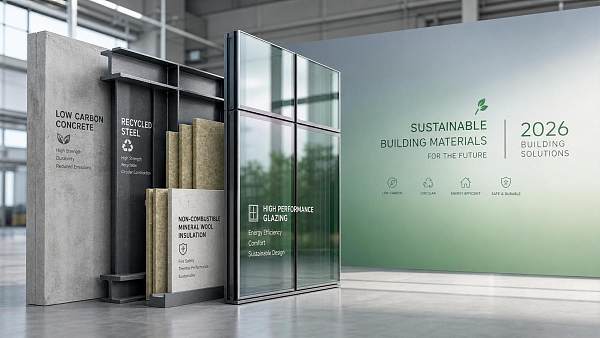
Among these groups, low-carbon concrete, recycled steel, noncombustible insulation, and specialty glass systems often rank highest for demanding facilities because they combine durability with familiar compliance pathways.
Where bio-based materials lead
Mass timber, cellulose insulation, cork, and other bio-based options remain strong sustainable building materials where lightweight construction, faster assembly, and carbon storage are important.
Their strongest performance appears in offices, education, hospitality, and selected residential or mixed-use schemes. They require tighter control in wet, contaminated, or high-heat process settings.
Where mineral and engineered systems lead
In semiconductor-related, aerospace, and energy-adjacent environments, engineered ceramics, specialty glass, corrosion-resistant metals, and noncombustible assemblies often outperform softer low-carbon alternatives.
These may not always appear in mainstream green-building conversations, yet they can deliver better lifecycle results when uptime, contamination control, or thermal stability drive the asset value.
The 2026 decision criteria shaping material selection
Embodied carbon remains important, but it is now one metric inside a wider decision framework. Better specifications connect environmental data with performance evidence.
- Verified environmental product declarations rather than generic sustainability claims.
- Fire, smoke, and toxicity behavior aligned with local code and insurer expectations.
- Resistance to moisture, chemicals, pressure variation, or thermal shock.
- Availability of regional supply and exposure to unstable raw material markets.
- Compatibility with fastening, sealing, filtration, and maintenance systems.
- End-of-life disassembly, reuse potential, or recycling quality.
This wider lens helps avoid a common mistake. A material can be low carbon at procurement stage and still become a poor sustainability choice once replacement cycles, contamination failures, or shutdown risks are considered.
How sustainable building materials behave in real project settings
Office and mixed-use developments often prioritize thermal efficiency, occupant comfort, and embodied carbon reporting. Here, hybrid structures, recycled metal content, high-performance glazing, and low-emission interiors usually perform well.
Industrial and technical facilities follow a different logic. Fire compartmentation, chemical resistance, cleanability, and process continuity can outweigh headline carbon savings.
Transport, logistics, and energy projects sit somewhere between those extremes. Materials must survive wear, exposure, maintenance traffic, and sometimes blast, vibration, or corrosive atmospheres.
That is why sustainable building materials should be specified as systems, not isolated products. The panel, substrate, insulation, coating, anchor, and sealant all affect long-term performance.
The importance of interfaces
Many failures begin at the interface. A low-carbon facade panel can still underperform if the connection detail creates thermal stress, corrosion, or serviceability issues.
The same applies to fire barriers, filtration housings, and high-spec glazing assemblies. Material sustainability improves when the entire interface is designed for inspection, replacement, and predictable aging.
Common mistakes in material benchmarking
Several specification errors continue to distort comparison between sustainable building materials.
- Comparing products with different service-life assumptions.
- Ignoring local installation skill and quality-control realities.
- Treating laboratory sustainability data as field performance proof.
- Overlooking compliance friction across ISO, UL, ATEX, or regional fire codes.
- Selecting novel materials without checking spare-part or repair ecosystems.
In practice, the most dependable material choice is often the one with the clearest evidence chain. That includes test data, certification alignment, supplier traceability, and known installation tolerances.
A workable approach for 2026 specifications
A useful shortlist starts with exposure conditions, expected service life, and maintenance access. Only after that should embodied carbon, recycled content, and circularity metrics be ranked.
For higher-risk assets, it also helps to align material review with adjacent systems. Fire protection, connection hardware, specialty glazing, filtration zones, and robotic maintenance access can all influence the best sustainable building materials choice.
This is where cross-disciplinary intelligence matters. A material that looks efficient in a narrow building model may underperform once procurement timing, safety certification, and operating stress are included.
The strongest 2026 decisions will come from balanced benchmarking. Compare environmental impact, structural behavior, compliance readiness, repair logic, and market stability at the same time.
If the next project involves stricter resilience targets, start by mapping exposure zones, critical interfaces, and certification pathways. Then review which sustainable building materials continue to perform when the building is treated as a long-life operating asset, not a short-term carbon report.
Recommended News
 Aug 15, 2026What to include in specification preparation support for custom projectsSpecification preparation support custom projects helps turn vague requirements into clear, actionable specs that reduce risk, improve procurement, and speed up successful delivery.
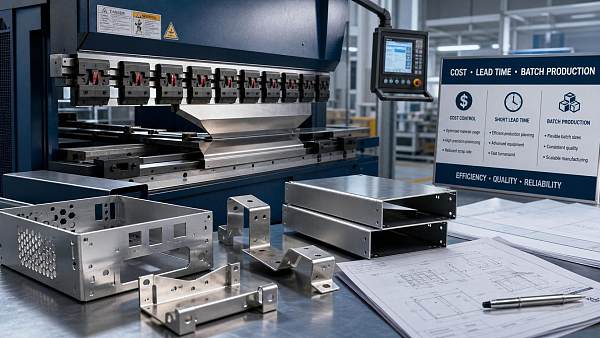
 Jul 02, 2026Sheet Metal Bending Services in Canada: Cost and Lead Time FactorsSheet metal bending services Canada: learn what drives cost and lead time, from material and bend complexity to capacity and quality control, so you can source smarter and reduce delivery risk.
 Jun 25, 2026Returnable Transport Packaging for Automotive Parts: Cost vs Damage ReductionReturnable transport packaging for automotive parts: compare upfront cost vs long-term damage reduction, labor savings, and cleaner line-side delivery in automotive supply chains.
 Jun 23, 2026Sustainable Building Materials: What Performs Best in 2026?Sustainable building materials in 2026: discover which options deliver the best durability, compliance, and lifecycle value for high-performance, future-ready projects.


All Categories
Hot Articles
- How to select hazardous area protection for offshore oil and gas sitesSep 12, 2026Hazardous area protection oil and gas guide for offshore sites—select certified, durable solutions that meet zoning, temperature, cable-entry, and maintenance demands.
- What to verify before choosing an electronics industry solutions supplierSep 11, 2026Electronics industry solutions supplier checklist: verify engineering expertise, traceability, compliance, quality controls, supply resilience, and lifecycle support before you buy.
- How to verify a supplier’s SIL metrics before selecting gas detectorsSep 10, 2026SIL metrics supplier guide: learn how to verify certificates, FMEDA data, proof tests, and lifecycle support before selecting gas detectors for safety-critical SIFs.