
How Lightweight Aerospace Fastening Solutions Affect Joint Strength
TIME
Click count
How Lightweight Aerospace Fastening Solutions Affect Joint Strength
The phrase aerospace fastening solutions lightweight sounds straightforward until it is applied to a real structure. Saving weight in a fastener is not the same as saving weight in a joint. A titanium bolt that is lighter than a steel alternative may still force a thicker stack-up, a larger washer footprint, a different hole quality requirement, or a stricter torque process. In other words, joint strength is governed by the whole load path, not by the catalog mass of the fastener alone. That distinction matters in aircraft primary structure, engine-adjacent assemblies, space hardware, and increasingly in advanced air mobility platforms, where designers are trying to remove grams without creating fatigue, galvanic, or maintenance problems somewhere else.
The first misconception is that “lightweight” automatically means lower strength. In aerospace practice, that is too crude. Lightweight fastening can mean several different strategies: switching from steel to titanium or aluminum alloy in selected locations; reducing fastener count through joint redesign; using blind fastening where access is limited; replacing some mechanical joints with bonded or hybrid joints; or optimizing head geometry, grip length, collar design, and clamp-up characteristics. Some of these choices preserve static strength well but alter fatigue behavior. Others improve assembly efficiency but narrow the process window. Technical evaluation therefore has to separate static joint capacity, stiffness, durability, inspectability, and environmental resistance rather than treating strength as a single number.
What changes when the fastener gets lighter
A joint carries load through bearing, clamp-up friction, shear transfer, and local deformation around the hole. Reducing fastener mass usually changes at least one of those mechanisms. Material substitution is the obvious example. Titanium fasteners are widely selected because they offer a favorable strength-to-weight ratio and good corrosion compatibility with carbon fiber reinforced polymer relative to some steel options. But titanium also has different elastic behavior and galling tendencies, and these affect tightening control, preload retention, and surface treatment requirements. If preload scatter increases, the theoretical weight saving can be offset by less predictable load sharing across a multi-fastener joint.
Head and shank geometry matter just as much. A lighter design may use a smaller head profile or reduced cross-section, but local bearing stress in the parent material rises if the contact area becomes too small. That is especially relevant in thin-gauge metallic skins and composite laminates, where the joint often fails not because the fastener fractures, but because the surrounding material experiences bearing damage, net-tension failure, delamination, or pull-through. In that context, a lighter fastener can weaken the joint even while the fastener itself remains comfortably within allowable stress.
There is also a stiffness issue that is often underappreciated. Joint stiffness influences load distribution between adjacent fasteners and between the fastener and the joined members. If a lightweight solution changes stiffness too much, the joint may see more micro-movement under cyclic loading. That can accelerate fretting, enlarge holes over time, and reduce fatigue life. Evaluators looking only at ultimate load values may miss this because the early warning signs tend to appear in durability testing, not in a short static qualification sequence.
Why composites complicate the answer
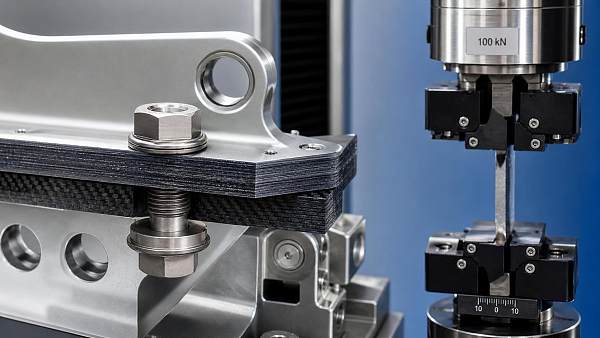
In metallic airframes, engineers have long experience balancing fastener preload, hole interference, and bearing stress. Composite structures introduce a different set of tradeoffs. Carbon fiber laminates do not yield the way metals do, so local stress concentrations and drilling quality become more critical. A lightweight fastening concept that works well in aluminum may be unacceptable in CFRP if it increases out-of-plane stress, causes delamination during installation, or creates galvanic exposure at the interface.
This is why aerospace joint design in composites often becomes a system problem involving fastener material, sleeve or bushing choice, sealant, washer geometry, hole tolerance, and assembly method. The fastener may be lighter, yet the joint may require additional local reinforcement to maintain acceptable damage tolerance. From a technical evaluation standpoint, that means the mass benefit must be assessed at assembly level rather than part level. A lighter bolt paired with a heavier laminate build-up is not necessarily a mass-saving solution.
Static strength is only one gate
When buyers or engineers ask whether a lightweight fastening solution is “strong enough,” they often mean ultimate tensile or shear capacity. Aerospace qualification is more demanding than that. The relevant question is whether the joint meets its required performance envelope under installation variation, vibration, thermal cycling, moisture exposure, corrosion risk, and repeated loading. A fastening concept can pass a nominal strength check and still perform poorly in service because clamp load relaxes, coatings degrade, or the assembled interface becomes sensitive to edge distance and hole quality.
For that reason, the standards environment matters. Depending on platform and application, evaluation may involve design allowables, process controls, material specifications, and quality requirements tied to aerospace OEM standards as well as broader frameworks such as ISO or NAS and MS part conventions where applicable. In many programs, the real engineering question is not whether a lightweight fastener exists, but whether its process capability and qualification evidence are strong enough to support repeatable compliance in production.
Where lightweight designs help, and where they can mislead
There are plenty of cases where reducing fastener weight is sensible. Secondary structures, interiors with stringent fire and smoke requirements, access-constrained zones using specialized blind fasteners, and composite-intensive assemblies can all benefit from refined fastening choices. In launch systems and satellites, cumulative savings from many small components can be meaningful, provided the thermal and vibration environment is fully addressed. The point is not that lightweighting is risky by default. It is that the engineering value appears only when the joint architecture, installation process, and duty cycle support it.
What misleads buyers is the habit of comparing fasteners in isolation. A lighter part can look favorable in a procurement table while hiding secondary effects: longer installation time, tighter hole preparation requirements, added insulating layers, more expensive inspection, or reduced field reparability. For technical evaluators, the correct unit of comparison is often the qualified joint configuration rather than the discrete fastener SKU.
Another common mistake is assuming that fewer fasteners always mean a stronger or more efficient joint. Sometimes reducing fastener count improves weight and simplifies assembly. Sometimes it increases local load per hole to the point that fatigue margins become harder to maintain. The answer depends on joint geometry, edge distance, pitch, member thickness, and whether the design relies primarily on bearing or friction transfer. Without that context, “fastener reduction” is a design direction, not a verdict.
What a technical review should actually ask
For aerospace procurement and technical assessment teams, useful questions are usually less glamorous than the product brochure. What is the validated installation window? How sensitive is achieved preload to lubrication and operator variation? Does the joint depend on close-tolerance holes or interference fit that will be difficult to sustain at production rate? How does the material pair behave in a corrosive or thermally variable environment? If the assembly is composite, what evidence exists on delamination control, bearing allowables, and damage tolerance? If removal is required during maintenance, does rework reduce structural margin?
Those questions reflect how joint strength is really lost in service. It is often not because the designer chose a weak fastener. It is because the assembly accumulated small process and interface errors that changed how load was transferred. Lightweight aerospace fastening solutions succeed when they control those variables tightly enough that the mass reduction remains real after certification, production, and maintenance are all considered together.
A more useful way to interpret “strength”
In aerospace programs, joint strength should be read as a combination of capacity, damage tolerance, fatigue life, environmental stability, and process repeatability. That is a broader definition than many non-specialists expect, but it reflects how critical structures are actually approved and managed. A fastening solution can be lighter and still be the right answer if it preserves that full package. It can also be lighter on paper and weaker in practice if it pushes risk into the interface, the installation process, or the maintenance cycle.
So when evaluating aerospace fastening solutions lightweight options, the practical question is not whether lower mass affects joint strength. It does. The real question is how it affects the joint: through clamp-up behavior, load sharing, local material response, fatigue, corrosion compatibility, and qualification evidence. Once that frame is clear, lightweighting stops being a marketing claim and becomes what it should be in aerospace engineering: a controlled structural trade backed by test logic, standards discipline, and a realistic understanding of service conditions.
Recommended News
 Jul 29, 2026How Lightweight Aerospace Fastening Solutions Affect Joint StrengthAerospace fastening solutions lightweight strategies can improve joint strength—or weaken it. Learn how preload, composites, fatigue, and material choices shape safer, lighter aerospace joints.
 Jul 14, 2026How Aerospace Fastening Solutions Reduce Rework in Aircraft AssemblyAerospace fastening solutions aircraft assembly teams use can cut rework, improve first-pass quality, and protect delivery schedules. Learn 5 practical ways to reduce costly assembly errors.
 Jul 10, 20265 Axis Milling Services for Aerospace: Tolerance, Lead Time, and Cost Factors5 axis milling services for aerospace explained: compare realistic tolerances, lead time risks, certification readiness, and true cost factors before choosing a supplier.
 Jul 04, 2026Aerospace Rivets in Aircraft Assembly: Strength, Fit, and Failure RisksAerospace rivets aircraft assembly insights on strength, fit, material pairing, and failure risks. Learn how to reduce fatigue, corrosion, and installation defects for safer, more reliable aircraft structures.

All Categories
Hot Articles
- How to select hazardous area protection for offshore oil and gas sitesSep 12, 2026Hazardous area protection oil and gas guide for offshore sites—select certified, durable solutions that meet zoning, temperature, cable-entry, and maintenance demands.
- What to verify before choosing an electronics industry solutions supplierSep 11, 2026Electronics industry solutions supplier checklist: verify engineering expertise, traceability, compliance, quality controls, supply resilience, and lifecycle support before you buy.
- How to verify a supplier’s SIL metrics before selecting gas detectorsSep 10, 2026SIL metrics supplier guide: learn how to verify certificates, FMEDA data, proof tests, and lifecycle support before selecting gas detectors for safety-critical SIFs.