How to verify ATEX compliance against enclosure specifications
TIME
Click count
An enclosure is suitable for an ATEX application only when its documented configuration and operating limits match the hazardous area and the equipment installed inside it. A marking on the housing is a useful starting point, but it does not by itself establish that a completed electrical assembly can be installed in a particular zone.
The practical test is a comparison across three records: the site’s hazardous-area requirements, the enclosure manufacturer’s certificate and instructions, and the specification of the finished assembly. Discrepancies between them can invalidate an otherwise credible selection. A suitable gas group, for example, does not compensate for an excessive surface temperature; an appropriate IP rating does not authorize an unapproved cable entry.
Start with the installation conditions, not the enclosure catalogue
Before checking a certificate number, establish what the installation actually requires. The area classification should identify the relevant gas or dust hazard and zone, using the site’s hazardous-area classification and explosion protection documentation. The evaluator also needs the substances involved, their ignition characteristics, ambient conditions and any external sources of heat.
For equipment intended for surface industries, the common category-to-zone relationship is shown below. It is a starting point for selection, subject to the applicable installation standard and any special conditions of the equipment.
A zone designation alone is not a complete specification. The assessment must also establish the applicable equipment group and, where relevant, subgroup. Group II covers equipment for explosive gas atmospheres in places other than mines susceptible to firedamp; Group III covers explosive dust atmospheres in those places. Group I has a separate mining application.
For gas equipment, IIC equipment is generally suitable where IIB or IIA is required, while an IIB marking does not automatically satisfy an IIC application. Dust subgroups have their own ordering and suitability rules; combustible flyings, non-conductive dust and conductive dust must not be treated as interchangeable. Where gas and dust hazards coexist, check that the equipment and its documented configuration address both.
Read the complete marking against the certificate
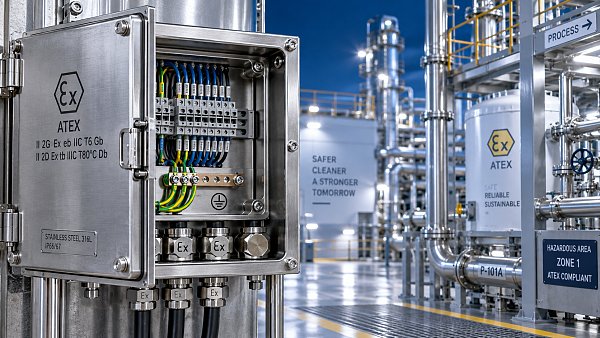
A typical equipment marking combines several pieces of information: the ATEX explosion-protection marking, equipment group and category, the applicable Ex protection concept, gas or dust subgroup, temperature information and equipment protection level. Read these as a set. A declaration that a product is “ATEX compliant” on a datasheet is too broad to substitute for the actual marking and supporting documents.
For example, a gas equipment marking that includes II 2G Ex db IIC T4 Gb conveys several separate attributes. It identifies Group II, Category 2 gas equipment, a flameproof protection concept, gas subgroup IIC, temperature class T4 and equipment protection level Gb. Its suitability still depends on the certificate, ambient range, installation instructions and the completed product configuration. It should not be assumed suitable for dust merely because the gas marking is comprehensive.
Cross-check the marking on the proposed unit against the manufacturer’s certificate and any amendments. The model designation, enclosure size, material, permitted fittings and operating range should correspond to the documents supplied. A certificate for a related model or a different enclosure variant is not enough.
Request the EU declaration of conformity for equipment placed on the EU market under the applicable ATEX product legislation, together with the instructions and, where applicable, the EU-type examination certificate and its schedules. Check which standards and editions the documents identify. ATEX Directive 2014/34/EU concerns equipment and protective systems placed on the market; Directive 1999/92/EC concerns minimum requirements for worker protection at sites with explosive atmospheres. The product documents and the site assessment therefore answer different questions.
Distinguish an enclosure component from finished equipment
One of the most consequential checks is whether the documentation covers an empty enclosure, an Ex component or the complete assembled equipment. An Ex component certificate, commonly identified by a certificate number ending in U, does not on its own establish compliance of the finished assembly. It defines conditions that must be taken into account when the component is incorporated into equipment.
Even where an enclosure is supplied as certified equipment, the certificate may limit what can be fitted inside it and how entries can be made. Adding terminals, switching devices, power supplies or heat-producing components can change the basis on which the finished assembly must be assessed. Establish who is responsible for the final conformity assessment and declaration; do not assume that the empty enclosure supplier’s paperwork covers another party’s completed panel.
Test the specification against the protection concept
The protection concept determines which construction details are safety-relevant. A datasheet dimension or material specification matters only if it is read alongside the certificate and instructions for that concept. The following checks are particularly important when reviewing enclosure drawings and bills of materials.
- Flameproof enclosures: Check permitted entries, stopping plugs, covers, fasteners and flamepath details. Drilling or machining outside the approved arrangements, changing fasteners or damaging a flamepath can affect the protection concept. The certificate and instructions determine what modifications are allowed.
- Increased safety assemblies: Check the permitted internal components, terminals, creepage and clearance arrangements where applicable, wiring, connections and heat dissipation. A housing with an increased-safety designation does not make every device placed inside it suitable.
- Dust protection by enclosure: Check the specified ingress protection, seals, cable entries and maximum surface temperature under the relevant conditions. Dust layers, cleaning practices and the ambient environment may affect the temperature assessment.
- Pressurized enclosures: Check the purge and pressurization arrangements, protective gas supply, monitoring, alarms or shutdown functions and the conditions for energizing the contents. The enclosure cannot be assessed independently of the associated protective system.
A product can use more than one protection concept for different parts of an assembly. The full marking and certificate define the combination; a single catalogue description such as “explosion-proof box” does not.
Ingress protection deserves particular care. An IP rating describes protection against ingress under the relevant test conditions; it is not an ATEX certification or a substitute for the prescribed explosion-protection measures. Conversely, an Ex marking does not automatically establish resistance to a site’s washdown chemicals, corrosion, impact exposure or outdoor weathering. Those requirements need their own comparison with the manufacturer’s specifications and instructions.
Check temperature limits using the complete assembly
For gas applications, the equipment temperature class must be compatible with the ignition temperature of the gas or vapour present. T4, for example, corresponds to a maximum surface temperature of 135 °C under the applicable conditions. A lower maximum surface temperature may be required for a more temperature-sensitive atmosphere. Do not select a class from the ambient temperature alone.
For combustible dust, equipment is marked with a maximum surface temperature rather than simply relying on the familiar gas temperature classes. Suitability depends on the dust’s ignition characteristics, the potential for dust clouds and layers, and the assessment rules applicable to the installation. A dust layer can insulate a surface and raise its temperature; housekeeping assumptions should match the way the site will actually operate.
Then examine the thermal basis of the assembly. The certificate or instructions may specify maximum permitted power dissipation, component placement, terminal loading, enclosure size or a reduced ambient range. Add up the heat sources using the manufacturer’s prescribed method, including credible operating conditions and any allowances required by the documentation. A nominal electrical rating by itself does not demonstrate that the enclosure remains within its certified temperature limit.
Ambient limits are equally important. If a certificate permits operation only within a stated range, compare that range with the local temperature around the enclosure, including solar exposure, nearby equipment and restricted ventilation where relevant. Heating, insulation or a sunshade may be part of the installation design, but their effect on certified conditions must be assessed rather than presumed acceptable.
Follow the conditions through to the installation drawing
A certificate number ending in X indicates that specific conditions of use apply. Those conditions may appear in the certificate, its schedule or associated instructions. They can concern matters such as electrostatic charging, mechanical impact protection, special fasteners, ambient temperature, cable entries or mounting. Identify each condition and record how the proposed installation will satisfy it.
The same discipline applies to accessories. Cable glands, stopping plugs, breathers and adapters must be suitable for the relevant atmosphere, protection concept and installation. Confirm thread form and size, entry arrangement, sealing method and any restrictions in both the enclosure and accessory documentation. A certified gland does not automatically make an arbitrary gland-and-enclosure combination acceptable.
Compare the final general arrangement and wiring drawings with the documentation actually assessed. Pay attention to the number and position of entries, unused openings, internal component list, terminal ratings, bonding arrangements and cover access. If a fabricator changes any of these after review, the change should return to the responsible party for assessment against the certificate and conformity documentation.
Make the approval decision traceable
A defensible review leaves a short, explicit record of how the proposed equipment meets the site requirements. For each important criterion, record the required value, the value claimed for the finished assembly and the document or drawing that supports it. At minimum, the record should cover zone and atmosphere, group and subgroup, temperature limits, protection concept, ambient range, enclosure configuration, entries and specific conditions of use.
Resolve mismatches before purchase or release for installation. A missing certificate amendment, an undefined internal heat load or an unclear division of responsibility for the finished panel is not merely an administrative gap: it may prevent the evaluator from establishing that the delivered configuration is the one covered by the conformity assessment.
Finally, preserve the instructions and approved configuration for inspection, maintenance and future modifications. Replacement seals, glands, covers or internal devices must remain consistent with the applicable documentation. The decision made during procurement stays useful only while the installed assembly continues to match the conditions on which it was approved.
Recommended News
 Nov 02, 2026How to verify ATEX compliance against enclosure specificationsExplore compliance specification articles and learn how to verify ATEX enclosure markings, certificates, temperature limits, and finished assembly requirements.
 Oct 26, 2026How to select an ATEX explosion-proof terminal box for Zone 1Select an ATEX explosion proof terminal box for Zone 1 with confidence. Discover key certification, loading and cable gland checks to avoid costly selection mistakes.
 Sep 21, 2026How to select an explosion proof air conditioner for a chemical plantChoose an explosion proof air conditioner for chemical plant use with confidence. Compare hazardous-area certification, temperature class, cooling load, corrosion resistance, installation, and maintenance requirements.
 Sep 19, 2026How to verify an explosion-proof stainless steel junction box is ATEX compliantStainless steel junction box explosion proof: learn how to verify ATEX marking, certificates, cable entries, temperature limits, and installation compliance.
All Categories
Hot Articles
- How to verify ATEX compliance against enclosure specificationsNov 02, 2026Explore compliance specification articles and learn how to verify ATEX enclosure markings, certificates, temperature limits, and finished assembly requirements.
- How does fused silica glass perform under thermal shock?Nov 01, 2026Discover how specialty glass fused silica resists thermal shock, what can cause cracking, and how to qualify components for demanding applications.
- How to verify a flame detector OEM supplier's certificationsOct 31, 2026Verify a flame detector OEM supplier's certifications with practical checks for model scope, official records and site requirements. Reduce procurement risks.