
How to Choose Aluminum Extrusions for Marine Applications
TIME
Click count
Choosing aluminum extrusions for marine applications is rarely a simple profile-and-price exercise. Salt exposure, cyclic loading, galvanic contact, fabrication methods, and classification expectations all influence long-term performance. In critical industrial environments, where G-CSE emphasizes verifiable engineering data and compliance-driven selection, the real question is not only which shape fits, but which extrusion system can endure service conditions without creating hidden maintenance, safety, or lifecycle risk.
Why marine extrusion selection deserves closer scrutiny
Marine structures operate in one of the most aggressive corrosion environments used in mainstream industry. Splash zones, trapped moisture, chloride deposits, and temperature swings can turn a low-cost choice into an expensive failure point.
That matters across shipbuilding, offshore platforms, port equipment, floating energy assets, control enclosures, walkways, robotic frames, and service modules. In these settings, weight reduction is valuable, but durability and predictable behavior matter more.
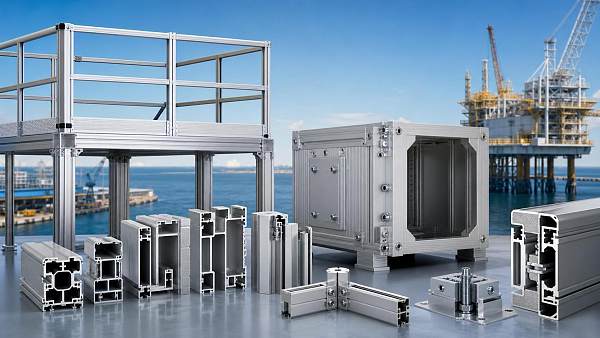
Aluminum extrusions for marine applications are attractive because they combine low density, good formability, and strong corrosion resistance. Even so, not every alloy, temper, finish, or joint detail performs equally well at sea.
What defines a suitable marine-grade extrusion
A marine-suitable extrusion is not defined by appearance alone. It is defined by how material chemistry, section geometry, finishing, joining, and installation details perform as one system.
In practice, aluminum extrusions for marine applications should resist pitting, crevice corrosion, stress concentration, and coating breakdown. They also need stable mechanical properties after machining, welding, or fastening.
The best selections usually balance five issues at once:
- Alloy suitability for chloride-rich environments
- Strength retention under working loads
- Compatibility with fabrication and assembly methods
- Surface protection matched to exposure level
- Documented compliance and traceable material data
Material grades usually considered first
When reviewing aluminum extrusions for marine applications, the 5xxx and 6xxx series usually receive the most attention. Each series serves different priorities, and misunderstanding that tradeoff often leads to poor specification.
5xxx series
Magnesium-alloyed 5xxx grades are widely respected for corrosion resistance in seawater service. They are common where welded assemblies and direct marine exposure are expected.
These grades can be attractive for structural members, deck hardware supports, and framework requiring dependable corrosion behavior. However, extrusion availability may be more limited than for common architectural alloys.
6xxx series
Silicon-magnesium 6xxx grades, including 6061 and 6082 in many markets, are frequently selected because they extrude well, machine well, and offer useful structural strength.
They are often used for ladders, rails, platforms, housings, equipment frames, and modular assemblies. Yet their corrosion behavior depends heavily on finish quality, drainage design, and connection details.
The right answer depends on exposure intensity, fabrication route, and whether the extrusion serves as a primary structure or a secondary support element.
Section design often matters as much as alloy choice
A well-chosen alloy can still fail early if the profile traps saltwater or creates inaccessible crevices. Geometry directly affects corrosion, stiffness, fatigue response, and inspection access.
Closed cavities should be reviewed carefully. If moisture enters but cannot drain, corrosion can progress unseen. Sharp internal corners also deserve attention because they raise local stress.
For aluminum extrusions for marine applications, practical profile design usually favors:
- Smooth drainage paths
- Reduced crevice-forming interfaces
- Adequate wall thickness for fastening and impact tolerance
- Accessible surfaces for coating, washing, and inspection
- Load paths that limit localized deformation
Surface treatment is a functional decision
Surface finishing is sometimes treated as a cosmetic afterthought. In marine service, it is part of the engineering specification.
Mill finish may be acceptable in mild indoor service near marine operations, but direct coastal exposure usually requires stronger protection. Anodizing, powder coating, or duplex approaches may improve durability when correctly specified.
Not all finishes solve the same problem. Anodizing improves surface hardness and corrosion resistance, yet edge damage and aggressive crevice conditions still need control. Powder coating can perform well, but pretreatment quality and coating continuity are decisive.
The better question is not which finish is popular, but which finish matches cleaning methods, UV exposure, abrasion, and repair practicality over the asset’s full service life.
Joining details can determine service life
Many failures linked to aluminum extrusions for marine applications begin at interfaces, not in the parent metal. Fasteners, weld zones, bonded joints, and mixed-metal connections need close review.
Galvanic corrosion is a recurring issue. Stainless steel fasteners may be necessary, but isolation washers, sealants, and thoughtful moisture management are often just as important.
Welding adds another layer of judgment. Heat-affected zones can alter strength and corrosion response, so the base alloy and temper must be evaluated together with the planned joining method.
Where modular replacement matters, bolted systems may be preferred. Where rigidity and fewer interfaces matter more, welded construction may justify the additional qualification burden.
Compliance, traceability, and environmental fit
In high-consequence sectors, material choice should not stop at datasheet strength values. Marine projects may also require alignment with classification society rules, ISO references, offshore specifications, fire performance limits, or customer-specific approval routes.
This is where the G-CSE perspective becomes useful. Benchmarking against international standards and cross-border compliance updates helps separate nominally similar extrusions from genuinely risk-controlled options.
Documentation worth checking includes mill certificates, alloy and temper traceability, finish process records, salt spray or corrosion test evidence where relevant, and fabrication qualification history.
A lower initial quote may lose value quickly if it lacks traceable chemistry, coating consistency, or evidence for performance in equivalent marine exposure.
A practical evaluation framework
For real-world screening, it helps to compare aluminum extrusions for marine applications through a short decision framework rather than through isolated specifications.
- Map the exposure zone: indoor coastal, splash, immersion, offshore, or chemically mixed marine service.
- Define the function: load-bearing, protective enclosure, access structure, equipment frame, or attachment member.
- Review alloy and temper against welding, machining, and fastening requirements.
- Check profile geometry for drainage, crevice control, and maintenance access.
- Specify the finish as a durability system, not a decorative option.
- Confirm traceability, standard alignment, and supplier process consistency.
This kind of structured review supports better lifecycle decisions, especially where the extrusion is integrated into critical systems, offshore maintenance equipment, or high-value support assemblies.
Where the next decision should focus
The most reliable aluminum extrusions for marine applications are usually chosen through context, not assumption. Exposure level, structural role, joining design, and compliance demands should be defined before profile comparison begins.
A useful next step is to build a short technical matrix covering alloy family, temper, section geometry, surface treatment, connection method, and required approvals. That makes supplier comparisons clearer and reduces the chance of selecting a profile that looks acceptable on paper but underperforms in service.
Where conditions are severe or documentation burdens are high, benchmarking candidate solutions against proven marine references and recognized standards is often the fastest way to improve confidence before final specification.
Recommended News
 Jun 23, 2026How to Choose Aluminum Extrusions for Marine ApplicationsAluminum extrusions for marine applications require the right alloy, profile, finish, and compliance. Learn how to reduce corrosion risk and choose durable, high-performance solutions.
![]() Apr 24, 2026Why multidisciplinary engineering matters in subsea ROVsMultidisciplinary engineering drives safer subsea ROVs in volatile environments, aligning high-pressure systems, safety protocols, and regulatory compliance for resilient energy infrastructure.
Apr 24, 2026Why multidisciplinary engineering matters in subsea ROVsMultidisciplinary engineering drives safer subsea ROVs in volatile environments, aligning high-pressure systems, safety protocols, and regulatory compliance for resilient energy infrastructure.

All Categories
Hot Articles
- How to select hazardous area protection for offshore oil and gas sitesSep 12, 2026Hazardous area protection oil and gas guide for offshore sites—select certified, durable solutions that meet zoning, temperature, cable-entry, and maintenance demands.
- What to verify before choosing an electronics industry solutions supplierSep 11, 2026Electronics industry solutions supplier checklist: verify engineering expertise, traceability, compliance, quality controls, supply resilience, and lifecycle support before you buy.
- How to verify a supplier’s SIL metrics before selecting gas detectorsSep 10, 2026SIL metrics supplier guide: learn how to verify certificates, FMEDA data, proof tests, and lifecycle support before selecting gas detectors for safety-critical SIFs.