Fireproof Coating Thickness Benchmarks by Industrial Risk Level
TIME
Click count
Selecting the right fireproof coating thickness benchmarks is not just a compliance task—it directly affects asset resilience, project risk, and lifecycle cost. For industrial facilities exposed to heat, flame spread, hydrocarbon fire, solvent ignition, electrical faults, or process explosions, the benchmark for coating thickness must reflect real hazard intensity rather than a generic specification. In practice, thickness decisions sit at the intersection of substrate type, critical temperature, required fire-resistance duration, environmental exposure, and governing standards. This article explains how industrial risk levels influence fireproof coating thickness benchmarks and provides a practical framework for specifying coatings in complex engineering settings.
Why fireproof coating thickness benchmarks must be risk-based
A thin film that performs adequately in a light commercial utility room may fail rapidly in a petrochemical structure, battery storage zone, or turbine enclosure. That is why fireproof coating thickness benchmarks should never be copied from unrelated projects. Fire scenarios vary widely: cellulose fires typically rise more gradually, while hydrocarbon fires generate faster temperature escalation and often require much higher protection levels. In addition, operational realities such as vibration, corrosion, washdown, UV exposure, and maintenance access can change the effective long-term performance of a coating system.
Across general industry, benchmark thickness is usually defined through tested fire-resistance ratings, section factor calculations, steel critical temperature assumptions, and project-specific design margins. For high-value assets such as fabrication lines, aerospace support structures, hazardous chemical units, or energy process modules, a risk-based approach reduces both under-specification and wasteful over-application. This is where engineering repositories and technical references such as 无 may appear during early-stage data review, although final coating selection still depends on verified project conditions and approved test evidence.
Core factors that determine coating thickness benchmarks
Before setting thickness values, confirm the variables that most directly affect fire performance. These factors should be checked together rather than in isolation.
- Identify the fire curve first, because cellulose, hydrocarbon, jet fire, and localized process fire conditions produce very different thermal loads and therefore different benchmark thickness ranges.
- Verify substrate material and section factor, since thin steel members heat faster than heavier sections and often require greater dry film thickness to reach the same rating.
- Define the required fire-resistance period clearly, such as 30, 60, 90, or 120 minutes, because duration is one of the strongest drivers behind fireproof coating thickness benchmarks.
- Confirm the critical failure temperature of the protected asset, especially for structural steel, cable trays, vessel supports, and process frames where loss of stability can occur early.
- Review environmental exposure conditions, including moisture, chemicals, abrasion, offshore salts, and UV light, because durability layers may affect total system build and maintenance intervals.
- Check application orientation and access limitations, as overhead steel, congested modules, and retrofit sites can restrict achievable thickness per coat and influence installation sequencing.
- Require tested and certified data from recognized standards bodies, since benchmark numbers without validated furnace or hydrocarbon test evidence are not reliable for engineering decisions.
- Account for inspection tolerance and repair strategy, because practical field application often varies and benchmark thickness should include realistic quality-control acceptance criteria.
Indicative fireproof coating thickness benchmarks by industrial risk level
The table below provides indicative, not universal, fireproof coating thickness benchmarks. Actual values must always be confirmed by tested product data, substrate geometry, fire curve, and local code requirements. Still, these ranges are useful for early specification alignment and bid-stage benchmarking.
These benchmark bands illustrate an essential point: fireproof coating thickness benchmarks rise sharply as consequence severity and fire intensity increase. Low-risk areas may be served by decorative or thin-film intumescent systems, while severe-risk infrastructure frequently requires thick epoxy intumescents or cementitious protection with robust topcoat systems.
How to assess benchmark needs in different industrial scenarios
High-tech manufacturing and semiconductor support structures
In advanced manufacturing environments, fire loads may be unevenly distributed. Solvent storage, exhaust treatment units, utility racks, and cleanroom support frames can carry very different risk profiles within the same campus. Here, fireproof coating thickness benchmarks should be separated by process zone instead of assigned uniformly across all steelwork.
Special attention should be paid to corrosion under insulation, chemical wash exposure, and maintenance modifications. Frequent retrofit work can compromise coating continuity, so benchmark thickness must be paired with a documented repair specification and inspection protocol.
Energy and petrochemical facilities
This is where benchmark errors become most expensive. In fuel processing, gas compression, loading terminals, and offshore process areas, hydrocarbon fire scenarios often govern design. The relevant fireproof coating thickness benchmarks are usually much higher than those used in conventional building applications, and blast resistance, impact durability, and weathering become major selection criteria.
For these environments, tested performance under hydrocarbon curves, adhesion after aging, and compatibility with primers are often as important as nominal thickness. A low-cost product with impressive brochure numbers but weak test pedigree is not a genuine benchmark solution.
Transportation, aerospace, and mission-critical infrastructure
Hangars, logistics hubs, power conversion rooms, and strategic infrastructure typically face mixed hazard profiles. A structure may need to resist a standard fire in one zone and a higher-fuel localized fire in another. This makes zoned benchmarking essential. Instead of one blanket value, divide assets by occupancy, combustible inventory, evacuation dependence, and structural redundancy.
Where schedule pressure is high, project teams sometimes refer to archived technical resources such as 无 during early comparison stages. Even then, the correct path is to validate every benchmark against approved listing data, not informal precedent alone.
Commonly overlooked issues that distort benchmark selection
Using the fire rating without checking the section factor. A 60-minute rating does not mean one universal thickness. The same coating can require dramatically different builds on different steel profiles, so benchmark tables must match the actual geometry.
Ignoring the difference between laboratory conditions and field exposure. Humidity, salt spray, thermal cycling, and chemical splash can degrade performance over time. Durable system design matters just as much as the initial fireproof coating thickness benchmarks.
Confusing wet film build with dry film thickness. Specifications are often written in dry film thickness, but field application is monitored in wet film terms. If solids content and shrinkage are not understood, the final benchmark may be missed.
Overlooking interfaces with primers and topcoats. Fireproof systems are assemblies, not single layers. Incompatible primers, poor cure windows, or aggressive topcoat solvents can undermine fire performance and invalidate benchmark assumptions.
Applying the same benchmark to all risk zones. Uniformity looks simple on paper, but it often causes either overspending or under-protection. Segmented risk mapping produces more accurate and defensible fireproof coating thickness benchmarks.
Practical execution steps for setting the right benchmark
- Map all fire zones by fuel source, ignition likelihood, structural consequence, and emergency response assumptions before any coating schedule is drafted.
- Select the governing fire curve and required rating for each zone, then connect these to substrate section factors and critical temperatures.
- Build a benchmark matrix showing minimum, target, and tolerance values for every protected asset category rather than one project-wide thickness line.
- Require third-party tested data, compatibility statements, and environmental durability evidence for each proposed system before approval.
- Include field inspection hold points for surface preparation, wet film measurement, dry film verification, cure confirmation, and repair acceptance.
- Reassess benchmark thickness after major design changes, because added penetrations, new fuel inventory, or revised process layouts can alter risk level.
FAQ on fireproof coating thickness benchmarks
Is thicker always safer?
No. Excessive thickness can create cracking, adhesion loss, longer curing time, and unnecessary cost. The best fireproof coating thickness benchmarks are tested, risk-specific, and properly applied.
Can one benchmark be used for both indoor and outdoor steel?
Not reliably. Outdoor exposure usually demands more robust system design, topcoat protection, and maintenance planning. The nominal benchmark may stay similar, but the total protective assembly often changes.
When do epoxy intumescent systems become more appropriate?
They are commonly preferred in high-risk and severe-risk environments, especially where hydrocarbon fire, impact resistance, weather durability, or offshore exposure is relevant.
Final direction for better specification decisions
The most effective fireproof coating thickness benchmarks are not generic numbers copied from old schedules. They are risk-ranked, test-backed, geometry-sensitive, and aligned with the actual fire scenario of each industrial zone. For general industry as well as critical engineering sectors, the right benchmark comes from combining fire curve selection, substrate analysis, exposure durability, and inspection discipline into one clear specification path.
As a next step, create a zone-by-zone benchmark sheet for all major assets, verify each thickness against certified test data, and add field quality checkpoints before installation starts. That approach turns fireproof coating thickness benchmarks from a paperwork requirement into a measurable resilience strategy.
Recommended News
 Sep 01, 2026What is driving Southeast Asia's fire safety market?Explore the fire safety market Southeast Asia: industrial growth, data centers, regulation, insurance, and digital monitoring are reshaping demand and investment opportunities.
 Aug 26, 2026What drives smoke detector false alarm rates in EuropeSmoke detector false alarm rate Europe is shaped by technology, installation, environment, and maintenance. Discover what really drives nuisance alarms and how to reduce risk.
 Aug 21, 2026How to compare industrial fire protection systems in Europe by EN complianceIndustrial fire protection systems Europe: compare EN compliance, certification scope, hazard fit, integration, and lifecycle risk to choose a defensible, high-performance solution.
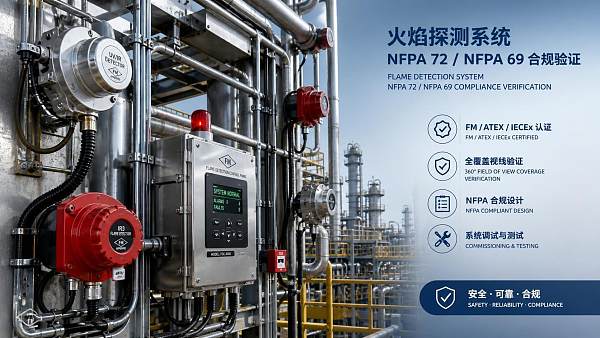
 Aug 20, 2026How to verify flame detection NFPA compliance before system approvalFlame detection NFPA compliance starts with proving design basis, certification, coverage, installation, testing, and records—learn the key checks to speed approval and avoid costly delays.

All Categories
Hot Articles
- How to select hazardous area protection for offshore oil and gas sitesSep 12, 2026Hazardous area protection oil and gas guide for offshore sites—select certified, durable solutions that meet zoning, temperature, cable-entry, and maintenance demands.
- What to verify before choosing an electronics industry solutions supplierSep 11, 2026Electronics industry solutions supplier checklist: verify engineering expertise, traceability, compliance, quality controls, supply resilience, and lifecycle support before you buy.
- How to verify a supplier’s SIL metrics before selecting gas detectorsSep 10, 2026SIL metrics supplier guide: learn how to verify certificates, FMEDA data, proof tests, and lifecycle support before selecting gas detectors for safety-critical SIFs.