
Fire Protection in Modular Construction: Code Issues and Fixes
TIME
Click count
Fire Protection in Modular Construction Starts with Scenario-Based Code Review
Fire protection in modular construction is no longer a peripheral compliance issue but a core engineering challenge for teams evaluating critical assets.
As modular delivery expands across plants, utility buildings, data facilities, and temporary infrastructure, code assumptions often lag behind design speed.
That gap creates real risk.
A module may satisfy factory quality checks yet still face rejection on site because fire separation, joint protection, or approval pathways were interpreted differently.
For this reason, fire protection in modular construction must be assessed as a full system, not as a set of isolated components.
The practical question is not whether modular buildings can be safe.
The real question is which project scenarios create the highest code friction, and how those issues can be fixed early.
Why Code Issues Change Across Modular Project Scenarios
Fire protection in modular construction varies by occupancy, hazard profile, transport method, and jurisdictional review style.
A healthcare module, a battery enclosure, and a worker accommodation unit may all use similar volumetric assembly methods.
However, their fire design logic differs sharply.
Some authorities focus on combustibility and structural ratings.
Others focus on active suppression, smoke control, or concealed intermodule cavities.
The challenge intensifies when fabrication occurs in one region and installation occurs in another.
Factory approvals do not automatically translate into site acceptance.
This is why early coordination among designers, testing bodies, inspectors, and logistics planners is essential for resilient fire protection in modular construction.
Scenario 1: Industrial Utility Modules Face Hidden Compartmentation Problems
Utility skids, control rooms, and packaged substations often appear compact and simple.
Yet they concentrate cables, penetrations, ventilation paths, and ignition sources inside tight envelopes.
A common code issue is the assumption that tested wall assemblies remain compliant after multiple field penetrations are added.
In practice, every new conduit, pipe, or cable tray can reduce fire resistance if sealing details are not tested or listed.
Another issue involves intermodule connections.
Joints between units are often treated as construction details rather than fire-critical interfaces.
That can leave gaps in continuity for barriers, smoke seals, and insulation.
Practical fixes for industrial modules
- Create a penetration register before fabrication begins.
- Match each opening with tested firestop details and substrate conditions.
- Treat intermodule joints as rated assemblies, not mere fit-up details.
- Verify cable coating, damper, and sealant compatibility with transport vibration.
Scenario 2: Multi-Unit Buildings Often Trigger Jurisdictional Approval Gaps
Residential, hospitality, and office modules frequently encounter approval delays because code officials review them through conventional building assumptions.
The most frequent disputes involve corridor ratings, floor-ceiling continuity, and the fire performance of connection zones.
For example, a rated wall tested in a laboratory may not reflect the exact stacking geometry used on site.
If module tolerances create voids, flames and smoke can travel in ways the original test never covered.
Fire protection in modular construction also becomes more complex when responsibilities are split among factory certifiers, local installers, and site inspectors.
Documentation gaps can lead to repeated inspections and costly rework.
Practical fixes for multi-unit approvals
- Map every tested assembly to the final installed configuration.
- Use engineering judgments only where accepted by the authority having jurisdiction.
- Prepare a single compliance matrix covering factory scope and site scope.
- Run pre-submission reviews with local fire officials before production release.
Scenario 3: High-Hazard Modules Demand More Than Basic Fire Ratings
Battery energy storage, chemical processing units, and explosive atmospheres require a broader protection strategy.
Here, fire protection in modular construction intersects with explosion venting, gas detection, pressure relief, and emergency isolation.
A wall rating alone does not resolve escalating internal events.
One recurring code issue is the misuse of generic materials in applications that need certified behavior under heat, blast, or corrosive exposure.
Another issue is assuming one standard governs the whole module.
In reality, compliance may involve building codes, electrical standards, hazardous location rules, and performance testing.
In technical benchmarking workflows, reference resources such as 无 may be reviewed alongside project-specific evidence.
Practical fixes for high-hazard modules
- Define the design fire scenario and escalation pathway early.
- Coordinate passive and active measures as one engineered package.
- Check compatibility between fireproofing, ventilation, and explosion relief geometry.
- Validate supplier certifications against the exact hazard classification.
Where Different Modular Scenarios Require Different Fire Protection Decisions
How to Adapt Fire Protection in Modular Construction Before Problems Escalate
Projects perform better when fire safety decisions are locked in before transport and craning plans are finalized.
Late modifications usually affect both compliance and structural integrity.
The following actions improve adaptation across most scenarios:
- Review tested assemblies against real installation tolerances.
- Assign ownership for factory work, transit protection, and site reinstatement.
- Document every field change that affects rated or sealed interfaces.
- Confirm local acceptance criteria for alternative methods and materials.
- Link fire strategy to maintenance access and future retrofit paths.
These actions are especially relevant in the comprehensive industry context, where modular systems often combine civil, mechanical, electrical, and process risks.
Common Misjudgments That Undermine Modular Fire Compliance
Several avoidable assumptions continue to weaken fire protection in modular construction.
- Assuming a listed material guarantees a compliant assembly.
- Ignoring shipping damage to sealants, wraps, dampers, or board edges.
- Treating intermodule voids as harmless construction tolerances.
- Overlooking mixed standards when modules include hazardous processes.
- Relying on shop drawings without site verification of final conditions.
Another frequent mistake is separating compliance paperwork from engineering evidence.
When drawings, test references, inspection records, and product data are fragmented, approval confidence drops.
In some cases, benchmark references such as 无 are used during comparison, but project acceptance still depends on traceable, installation-specific proof.
What to Do Next for Stronger Project Resilience
The best next step is to run a scenario-based gap review before fabrication freeze.
Start with occupancy, hazard level, transport constraints, and local code pathway.
Then compare tested assemblies, joint details, suppression concepts, and authority expectations against the actual build sequence.
Fire protection in modular construction becomes far more manageable when design teams define evidence requirements early and keep them aligned through installation.
That approach reduces redesign, shortens approval cycles, and supports resilient performance for critical infrastructure under demanding operational conditions.
Recommended News
 Sep 01, 2026What is driving Southeast Asia's fire safety market?Explore the fire safety market Southeast Asia: industrial growth, data centers, regulation, insurance, and digital monitoring are reshaping demand and investment opportunities.
 Aug 26, 2026What drives smoke detector false alarm rates in EuropeSmoke detector false alarm rate Europe is shaped by technology, installation, environment, and maintenance. Discover what really drives nuisance alarms and how to reduce risk.
 Aug 21, 2026How to compare industrial fire protection systems in Europe by EN complianceIndustrial fire protection systems Europe: compare EN compliance, certification scope, hazard fit, integration, and lifecycle risk to choose a defensible, high-performance solution.
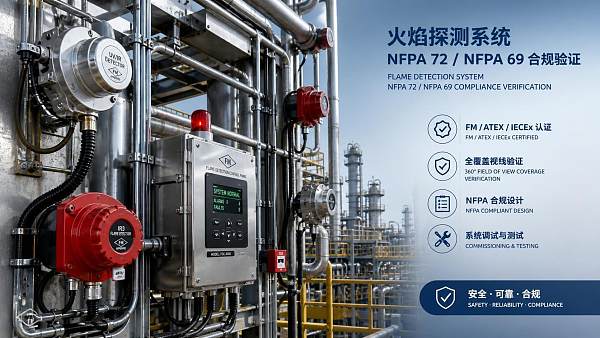
 Aug 20, 2026How to verify flame detection NFPA compliance before system approvalFlame detection NFPA compliance starts with proving design basis, certification, coverage, installation, testing, and records—learn the key checks to speed approval and avoid costly delays.

All Categories
Hot Articles
- How to select hazardous area protection for offshore oil and gas sitesSep 12, 2026Hazardous area protection oil and gas guide for offshore sites—select certified, durable solutions that meet zoning, temperature, cable-entry, and maintenance demands.
- What to verify before choosing an electronics industry solutions supplierSep 11, 2026Electronics industry solutions supplier checklist: verify engineering expertise, traceability, compliance, quality controls, supply resilience, and lifecycle support before you buy.
- How to verify a supplier’s SIL metrics before selecting gas detectorsSep 10, 2026SIL metrics supplier guide: learn how to verify certificates, FMEDA data, proof tests, and lifecycle support before selecting gas detectors for safety-critical SIFs.