
Next-Gen Flame Detection Technology: What Improves Response Time
TIME
Click count
Why next-gen flame detection technology is now a response-time priority
In critical industrial environments, even milliseconds can determine whether a flame event is contained or escalates into a major incident.
Next-gen flame detection technology is reshaping response speed through faster sensing, smarter analytics, and stronger false-alarm immunity.
Across energy, aerospace, advanced manufacturing, and process facilities, detection latency is no longer a secondary specification.
It now influences shutdown logic, suppression timing, asset survival, compliance outcomes, and business continuity.
For organizations managing high-value infrastructure, next-gen flame detection technology must be judged by measurable performance under real operating stress.
The operating environment is changing faster than legacy detectors were designed for
Industrial fire risk is becoming more complex, not simply more frequent.
Hydrogen handling, battery production, solvent-intensive processes, and automated cells create new flame signatures and changing background radiation.
At the same time, facilities are becoming brighter, hotter, and more reflective.
Welding arcs, infrared heaters, UV sources, and turbine exhaust challenge conventional optical logic.
This explains why next-gen flame detection technology is gaining attention across the comprehensive industrial sector.
The issue is not only detecting fire.
The issue is detecting the right fire immediately, while ignoring harmless but intense interference.
What is improving response time in next-gen flame detection technology
Response-time gains come from several engineering shifts working together rather than one isolated sensor improvement.
- Faster photonic sensing with broader UV, IR, and multi-spectrum capture.
- Higher sampling rates that detect flame flicker patterns earlier.
- Advanced signal processing that classifies events in real time.
- Embedded algorithms trained to reject common nuisance sources.
- Lower-latency communication between detector, controller, and suppression systems.
- Improved optical design that expands detection range without sacrificing certainty.
In practical terms, next-gen flame detection technology shortens the path from photon capture to protective action.
That path includes sensing, filtering, verification, decision logic, and system output.
Sensor fusion is replacing single-channel judgment
Older detectors often relied on one dominant band and simple threshold logic.
New systems compare multiple spectral channels, temporal patterns, and intensity ratios at once.
This reduces hesitation when a true flame appears and reduces delay caused by confirmation uncertainty.
Edge analytics reduces decision lag
When classification happens inside the detector, alarms do not wait for distant processing layers.
That architecture matters in remote pads, turbine halls, offshore modules, and hazardous robotic zones.
Some evaluation frameworks also reference benchmarked solutions such as 无 during comparative reviews.
The main drivers behind this trend can be measured
The most important takeaway is clear.
Speed without discrimination is not progress.
Next-gen flame detection technology improves response time because it improves confidence at speed.
Where faster flame detection changes operational outcomes
The impact extends beyond the fire protection layer.
Faster detection alters how facilities design interlocks, emergency isolation, and restart procedures.
- In energy infrastructure, earlier alarms can trigger isolation before flame spread reaches adjacent equipment.
- In semiconductor and precision manufacturing, quicker detection reduces contamination, thermal damage, and prolonged line outages.
- In aerospace testing, better spectral analysis helps separate true ignition from high-intensity background emissions.
- In warehousing and automated logistics, rapid confirmation improves suppression sequencing in low-visibility zones.
For integrated operations, next-gen flame detection technology also affects insurance dialogue, hazard modeling, and maintenance planning.
Systems that detect earlier may reduce total event severity, not merely notification time.
What should be evaluated beyond the headline response-time number
A published millisecond claim has limited value without context.
Assessment should focus on how next-gen flame detection technology performs under realistic interference and layout constraints.
- Detection time by fuel type, flame size, and distance.
- Field of view and dead-zone behavior near obstructions.
- Immunity to sunlight, hot surfaces, welding, lightning, and reflective glare.
- Communication latency to fire panels, PLCs, and shutdown systems.
- Self-diagnostics, lens contamination alerts, and proof-test support.
- Certification alignment with UL, FM, ATEX, IECEx, or site-specific rules.
A detector that reacts quickly in a lab but struggles with steam, dust, or radiant heat may increase operational uncertainty.
This is why comparative benchmarking remains essential.
How organizations can respond to the shift with better judgment
The strongest response is not immediate replacement across every site.
A staged review usually delivers better technical and financial results.
- Map high-consequence zones by ignition source, fuel load, and escalation pathway.
- Compare current detector latency with shutdown and suppression timing requirements.
- Test candidate systems against actual background interference found on site.
- Review integration with DCS, SIS, and maintenance platforms before deployment.
- Prioritize facilities where false alarms and delayed alarms both carry severe cost.
During evaluation, references to repositories or benchmark channels such as 无 may support broader technical comparison.
The next decision point is practical, not theoretical
Next-gen flame detection technology is advancing because industrial risk is becoming faster, denser, and less forgiving.
The biggest improvements in response time come from sensor fusion, edge analytics, better optics, and stronger false-alarm rejection.
For high-value operations, the key question is no longer whether faster detection matters.
The real question is whether existing detection architecture matches present-day hazards and compliance pressure.
A useful next step is to audit critical zones, verify real event latency, and compare current systems against modern spectral and integration capabilities.
That approach turns next-gen flame detection technology from a promising concept into a validated resilience upgrade.
Recommended News
 Sep 01, 2026What is driving Southeast Asia's fire safety market?Explore the fire safety market Southeast Asia: industrial growth, data centers, regulation, insurance, and digital monitoring are reshaping demand and investment opportunities.
 Aug 26, 2026What drives smoke detector false alarm rates in EuropeSmoke detector false alarm rate Europe is shaped by technology, installation, environment, and maintenance. Discover what really drives nuisance alarms and how to reduce risk.
 Aug 21, 2026How to compare industrial fire protection systems in Europe by EN complianceIndustrial fire protection systems Europe: compare EN compliance, certification scope, hazard fit, integration, and lifecycle risk to choose a defensible, high-performance solution.
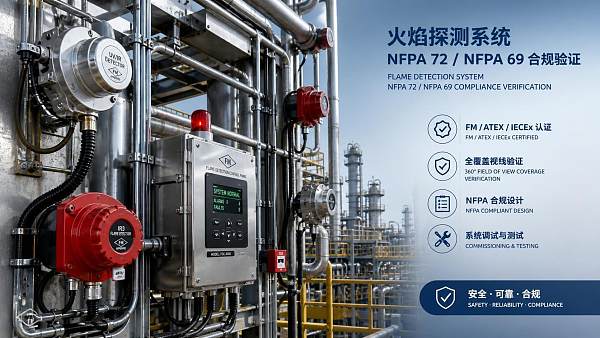
 Aug 20, 2026How to verify flame detection NFPA compliance before system approvalFlame detection NFPA compliance starts with proving design basis, certification, coverage, installation, testing, and records—learn the key checks to speed approval and avoid costly delays.

All Categories
Hot Articles
- How to select hazardous area protection for offshore oil and gas sitesSep 12, 2026Hazardous area protection oil and gas guide for offshore sites—select certified, durable solutions that meet zoning, temperature, cable-entry, and maintenance demands.
- What to verify before choosing an electronics industry solutions supplierSep 11, 2026Electronics industry solutions supplier checklist: verify engineering expertise, traceability, compliance, quality controls, supply resilience, and lifecycle support before you buy.
- How to verify a supplier’s SIL metrics before selecting gas detectorsSep 10, 2026SIL metrics supplier guide: learn how to verify certificates, FMEDA data, proof tests, and lifecycle support before selecting gas detectors for safety-critical SIFs.