Industrial Fire Suppression System OEM: Key Design Checks
TIME
Click count
Selecting an industrial fire suppression system OEM requires more than price or catalog claims. Technical review must connect hazard severity, process continuity, and compliance evidence. In complex industrial settings, an unsuitable design can create delayed discharge, agent incompatibility, or post-event downtime. A disciplined design-check framework helps validate whether an OEM can protect critical assets under real operating conditions, not only under brochure assumptions.
Definition and Scope of an Industrial Fire Suppression System OEM
An industrial fire suppression system OEM designs and supplies integrated fire control solutions for industrial risks. The scope usually includes detection, control logic, suppression agent storage, discharge hardware, alarms, and supporting documentation.
Unlike basic commercial systems, industrial configurations must address process hazards, ignition sources, confined spaces, dust, flammable liquids, energized equipment, and shutdown interlocks. Design quality depends on engineering depth, not only on component availability.
For critical industries, the OEM must also align with standards and approval routes such as UL, FM, NFPA references, ATEX, IECEx, ISO-driven quality controls, and local authority requirements.
Core design boundaries
- Protected hazard type and fire class
- Environmental temperature, pressure, and corrosion exposure
- Detection speed and release sequence logic
- Agent effectiveness and equipment compatibility
- Inspection, refill, testing, and spare parts support
Why the Market Focus on Industrial Fire Suppression System OEM Capability Is Increasing
Industrial risk conditions are changing. Facilities now combine automation, dense electrical loads, battery systems, solvent chemistry, hydrogen handling, and stricter uptime targets. This raises the value of a capable industrial fire suppression system OEM.
Regulatory pressure is also increasing. Cross-border projects often require documented evidence of design calculations, listed components, explosion protection suitability, and maintenance traceability across the asset lifecycle.
In this environment, selecting an industrial fire suppression system OEM becomes a technical risk-management decision. Performance proof, integration discipline, and service continuity often outweigh a low initial quotation.
Key Design Checks Before Approving an Industrial Fire Suppression System OEM
A robust review should start with hazard mapping. The OEM should identify ignition points, fuel sources, occupancy conditions, ventilation effects, and escalation paths. Generic zoning is not enough for real industrial fire scenarios.
1. Hazard mapping and fire scenario definition
Check whether the OEM defines credible scenarios, including hidden fires, flash events, enclosure fires, cable tray spread, and re-ignition risk. Protection intent must be explicit: control, suppression, or extinguishment.
2. Agent compatibility with process and assets
The chosen agent must match the hazard. Water mist, clean agent, foam, dry chemical, inert gas, and hybrid systems each have limitations. Verify residue effects, thermal shock risk, conductivity concerns, and material interaction.
For electronics, archives, cleanrooms, and control cabinets, post-discharge contamination may be unacceptable. For hydrocarbon storage or fuel transfer zones, foam performance and containment design become essential.
3. Detection architecture and release logic
An industrial fire suppression system OEM should document detector type, placement rationale, voting logic, and fail-safe behavior. Confirm whether heat, flame, smoke, gas, or multi-criteria detection is suitable for the environment.
Release logic should address manual override, abort stations, pre-discharge alarms, shutdown commands, damper closure, ventilation isolation, and restart conditions. Sequence errors often create the largest operational risk.
4. Hydraulic, pneumatic, or flow calculation integrity
Ask for nozzle coverage, pipe sizing, pressure losses, discharge duration, and reserve calculations. If the OEM cannot explain assumptions, field performance may differ from design intent.
5. Certification route and documentation completeness
A credible industrial fire suppression system OEM should provide approvals, datasheets, installation manuals, cause-and-effect matrices, inspection procedures, and traceable component records. Documentation gaps can delay project acceptance or insurance approval.
6. Maintainability and lifecycle support
System effectiveness declines when service intervals are unclear or refill logistics are weak. Review spare parts lead times, cylinder recertification plans, software support, training scope, and regional service capability.
Business Value of a Well-Qualified Industrial Fire Suppression System OEM
The value of the right industrial fire suppression system OEM extends beyond code compliance. Better design checks can reduce unplanned shutdowns, limit equipment loss, improve restart speed, and strengthen insurer confidence.
For high-value facilities, suppression design also influences process continuity. A system that controls a fire but damages adjacent assets may meet minimum intent while failing business resilience goals.
- Lower probability of under-protection or false discharge
- Better alignment with audit, insurer, and authority expectations
- Improved serviceability over long asset lifecycles
- Reduced retrofit cost after late-stage compliance findings
- Stronger resilience for critical production and infrastructure
Typical Industrial Scenarios and OEM Evaluation Priorities
Not all applications require the same suppression strategy. The best industrial fire suppression system OEM demonstrates application-specific engineering rather than a single preferred solution.
Practical Review Steps and Common Design Risks
During technical review, it is useful to challenge assumptions directly. Many failures arise from boundary conditions that were never tested against the actual process environment.
Recommended review checklist
- Confirm hazard study inputs and protected asset inventory.
- Verify agent suitability against materials, occupancy, and cleanup limits.
- Review cause-and-effect logic for alarm, release, shutdown, and reset.
- Check calculation packages and nozzle placement drawings.
- Match certifications to project geography and hazardous area classification.
- Examine maintenance manuals, refill path, and spare parts commitments.
- Request reference cases in similar industrial duty conditions.
Frequent risks
- Using a listed component set without validating system integration
- Assuming one agent works equally well across mixed hazards
- Ignoring enclosure leakage or ventilation impact on concentration hold time
- Underestimating training and post-discharge recovery requirements
Next-Step Evaluation Framework
A structured comparison matrix can improve selection quality. Score each industrial fire suppression system OEM on hazard understanding, certification strength, integration quality, maintainability, and evidence from comparable installations.
Where asset criticality is high, request a formal design review package before final approval. This should include scenario assumptions, calculation summaries, interface logic, and service commitments over the expected operating life.
In industrial environments, fire protection decisions shape safety, uptime, insurance outcomes, and capital preservation. The most reliable industrial fire suppression system OEM is the one that proves design fitness under real conditions, with transparent engineering evidence and long-term support capability.
Recommended News
 Sep 01, 2026What is driving Southeast Asia's fire safety market?Explore the fire safety market Southeast Asia: industrial growth, data centers, regulation, insurance, and digital monitoring are reshaping demand and investment opportunities.
 Aug 26, 2026What drives smoke detector false alarm rates in EuropeSmoke detector false alarm rate Europe is shaped by technology, installation, environment, and maintenance. Discover what really drives nuisance alarms and how to reduce risk.
 Aug 21, 2026How to compare industrial fire protection systems in Europe by EN complianceIndustrial fire protection systems Europe: compare EN compliance, certification scope, hazard fit, integration, and lifecycle risk to choose a defensible, high-performance solution.
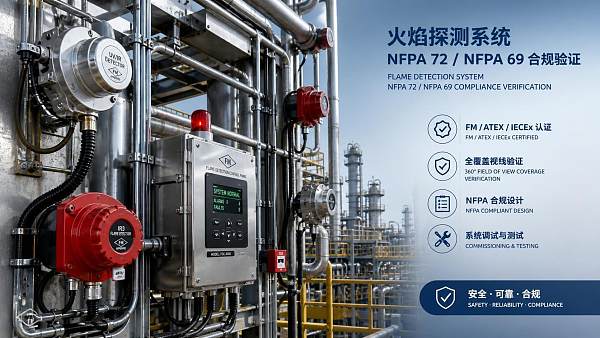
 Aug 20, 2026How to verify flame detection NFPA compliance before system approvalFlame detection NFPA compliance starts with proving design basis, certification, coverage, installation, testing, and records—learn the key checks to speed approval and avoid costly delays.

All Categories
Hot Articles
- How to select hazardous area protection for offshore oil and gas sitesSep 12, 2026Hazardous area protection oil and gas guide for offshore sites—select certified, durable solutions that meet zoning, temperature, cable-entry, and maintenance demands.
- What to verify before choosing an electronics industry solutions supplierSep 11, 2026Electronics industry solutions supplier checklist: verify engineering expertise, traceability, compliance, quality controls, supply resilience, and lifecycle support before you buy.
- How to verify a supplier’s SIL metrics before selecting gas detectorsSep 10, 2026SIL metrics supplier guide: learn how to verify certificates, FMEDA data, proof tests, and lifecycle support before selecting gas detectors for safety-critical SIFs.