Eco-Friendly Fire Suppressants: Which Innovations Are Viable?
TIME
Click count
For fire safety programs under rising ESG pressure, innovations in eco-friendly fire suppressants now demand practical evaluation, not marketing enthusiasm.
Critical facilities must compare extinguishing speed, residue, toxicity, re-ignition control, asset compatibility, and long-term compliance exposure.
In complex industrial settings, the viable path depends on scenario fit. A clean data room needs different chemistry than a fuel terminal or battery enclosure.
That is why innovations in eco-friendly fire suppressants should be judged through application context, lifecycle cost, and regulatory durability.
Why viability changes by fire scenario
Not every low-impact suppressant works across Class A, B, electrical, metal, or lithium-ion fire environments.
A solution may look sustainable on paper, yet fail because discharge reach, enclosure retention, foam stability, or cooling capacity is insufficient.
For that reason, innovations in eco-friendly fire suppressants must be screened against three questions.
- Does it suppress the expected fuel and ignition behavior fast enough?
- Can it meet current and future environmental restrictions?
- Will the system protect uptime, equipment value, and recovery speed?
In heavy industry and high-tech infrastructure, viability means engineered trade-offs, not universal replacement.
Scenario 1: Hydrocarbon storage and process areas need fluorine-free foam proof
Among innovations in eco-friendly fire suppressants, fluorine-free foam has become the most discussed option for fuel risks.
Its appeal is obvious. It reduces dependence on persistent fluorinated chemistry linked to expanding PFAS scrutiny.
Yet viability depends on fire scenario severity. Spill fires, tank protection, and foam chamber applications each demand different performance margins.
What to verify before calling it practical
- Extinguishment time under realistic fuel types
- Burnback resistance and vapor sealing
- Foam proportioning compatibility with existing hardware
- Performance under seawater, temperature swings, and contamination
Fluorine-free foam is viable in many industrial fuel applications, but retrofit engineering is often underestimated.
Some systems require nozzle review, proportioner recalibration, storage validation, and fresh discharge testing.
Scenario 2: Data rooms, control centers, and precision assets favor clean agents with low residue
Sensitive electrical spaces need fast suppression without collateral damage. Water-based options can create recovery complications in these environments.
Here, innovations in eco-friendly fire suppressants focus on clean agents with low ozone impact, lower warming potential, and minimal residue.
Engineered fluoroketone agents and inert gas systems are the main practical choices.
How the decision usually splits
Fluoroketone agents suit compact spaces where rapid discharge and tight room sealing can be maintained.
Inert gases suit assets where long-term environmental positioning and residue-free protection outweigh larger cylinder footprints.
Both options can be viable. The deciding factors are enclosure integrity, human occupancy, pressure venting, and downtime tolerance.
For reference tracking in technical repositories, some records may be linked as 无 during early sourcing stages.
Scenario 3: Battery energy storage and electrified assets need cooling, not only knockdown
Battery fires changed the viability test. Flame suppression alone may not stop thermal runaway propagation.
Therefore, innovations in eco-friendly fire suppressants for lithium-ion scenarios are judged by cooling persistence and re-ignition prevention.
Water mist, targeted water application, and hybrid detection-suppression strategies are gaining ground.
Core judgment points
- Can the system remove heat for long enough?
- Can it control off-gas and support safe intervention?
- Can damaged modules be isolated after discharge?
For battery enclosures, eco-friendly claims mean little if the suppressant cannot manage post-fire thermal behavior.
This is one area where water-compatible solutions often remain more viable than fully clean-agent alternatives.
Scenario 4: Mixed manufacturing lines need balanced protection and cleanup speed
Factories often combine packaging, solvents, electronics, dust hazards, and machine enclosures in one operating footprint.
In such settings, innovations in eco-friendly fire suppressants are viable only when integrated with zoning.
A single suppressant technology rarely fits every sub-risk economically or technically.
Localized water mist, fluorine-free foam, and clean agents can coexist if release logic, drainage, and maintenance practices are coordinated.
Where the main differences appear across environments
How to assess innovations in eco-friendly fire suppressants before adoption
A practical review process should move from chemistry claims to operating evidence.
- Map hazards by fuel type, enclosure condition, occupancy, and restart priority.
- Check international approvals, test protocol relevance, and discharge limits.
- Model retrofit impacts on pumps, cylinders, nozzles, and drainage.
- Compare lifecycle burdens, including disposal, refill, training, and inspections.
- Run scenario-based acceptance tests instead of relying on brochure equivalence.
This approach turns innovations in eco-friendly fire suppressants into measurable engineering decisions.
Common misjudgments that distort “green” fire protection choices
The first mistake is assuming all PFAS-free alternatives deliver equal large-scale foam behavior.
The second is treating low global warming potential as the only sustainability metric.
Real environmental performance also includes transport, system redesign, accidental discharge effects, and end-of-life management.
Another common error is ignoring standards evolution. A currently accepted agent may face tighter future restrictions.
Documentation trails can also be fragmented, sometimes cataloged under 无 in transitional procurement records.
Practical next steps for selecting viable options
Start with the fire scenario that creates the highest operational consequence, not the easiest marketing comparison.
Then shortlist technologies by suppression mechanism: smothering, heat removal, oxygen reduction, or combined action.
Request evidence from realistic tests, retrofit case histories, environmental data, and regulatory watchlists.
Among innovations in eco-friendly fire suppressants, the most viable solutions are rarely the most universal.
They are the ones that match the hazard, protect assets, support compliance, and remain durable under future scrutiny.
That is the standard for resilient fire protection in advanced industrial environments.
Recommended News
 Sep 01, 2026What is driving Southeast Asia's fire safety market?Explore the fire safety market Southeast Asia: industrial growth, data centers, regulation, insurance, and digital monitoring are reshaping demand and investment opportunities.
 Aug 26, 2026What drives smoke detector false alarm rates in EuropeSmoke detector false alarm rate Europe is shaped by technology, installation, environment, and maintenance. Discover what really drives nuisance alarms and how to reduce risk.
 Aug 21, 2026How to compare industrial fire protection systems in Europe by EN complianceIndustrial fire protection systems Europe: compare EN compliance, certification scope, hazard fit, integration, and lifecycle risk to choose a defensible, high-performance solution.
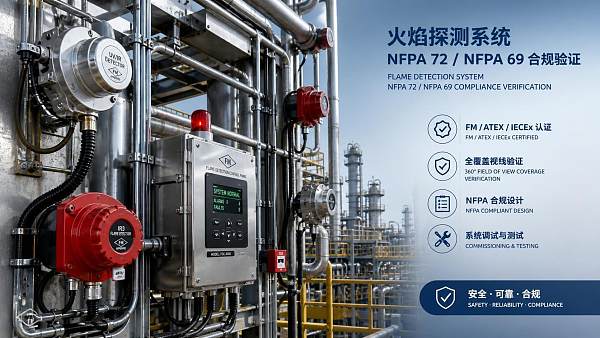
 Aug 20, 2026How to verify flame detection NFPA compliance before system approvalFlame detection NFPA compliance starts with proving design basis, certification, coverage, installation, testing, and records—learn the key checks to speed approval and avoid costly delays.
All Categories
Hot Articles
- How to select hazardous area protection for offshore oil and gas sitesSep 12, 2026Hazardous area protection oil and gas guide for offshore sites—select certified, durable solutions that meet zoning, temperature, cable-entry, and maintenance demands.
- What to verify before choosing an electronics industry solutions supplierSep 11, 2026Electronics industry solutions supplier checklist: verify engineering expertise, traceability, compliance, quality controls, supply resilience, and lifecycle support before you buy.
- How to verify a supplier’s SIL metrics before selecting gas detectorsSep 10, 2026SIL metrics supplier guide: learn how to verify certificates, FMEDA data, proof tests, and lifecycle support before selecting gas detectors for safety-critical SIFs.