Explosion Protection Enclosures: ATEX vs IECEx Compliance Differences
TIME
Click count
Explosion protection enclosures sit at the intersection of safety engineering, regulatory control, and asset reliability. When equipment is planned for hazardous areas, the difference between ATEX and IECEx is not a paperwork detail. It affects approval paths, technical files, installation confidence, and whether the same enclosure can move smoothly across regions, projects, and operating environments.
That is why the ATEX versus IECEx discussion has become more relevant across energy, process manufacturing, aerospace support systems, advanced fabrication, and other high-consequence sectors. In practice, both systems aim to reduce ignition risk, but they do not operate in the same legal structure or market context. For organizations comparing explosion protection enclosures, that difference shapes engineering decisions long before procurement closes.
What explosion protection enclosures are designed to do
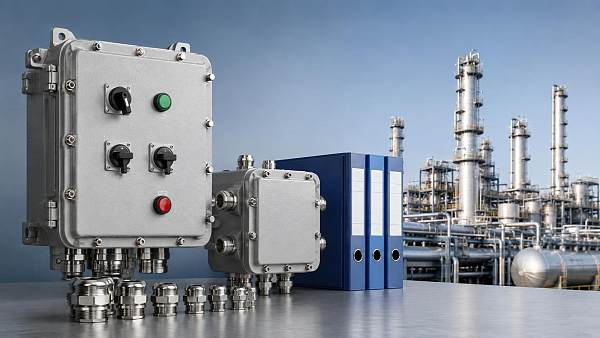
Explosion protection enclosures are built to contain, isolate, or prevent ignition hazards in areas where flammable gas, vapor, mist, or dust may be present. Their purpose is not simply to shield components. They are part of a wider protection concept that connects enclosure strength, sealing integrity, thermal behavior, cable entry design, and system certification.
Depending on the protection method, the enclosure may resist an internal explosion, prevent ingress of hazardous material, limit surface temperature, or support pressurization. This matters in applications such as control stations, junction boxes, operator panels, analyzer housings, motor terminal boxes, and instrument cabinets.
In real projects, enclosure selection is rarely isolated. Material compatibility, corrosion exposure, maintenance access, ambient temperature, and inspection regime all influence whether a certified design remains suitable over time.
ATEX and IECEx share technical roots, but not the same framework
ATEX is a European regulatory regime. It is linked to EU directives and places legal obligations on equipment entering the European market. IECEx is an international certification scheme based on IEC standards. It is not a law by itself, but a globally recognized conformity system accepted or referenced by many jurisdictions.
This distinction is the starting point for understanding compliance differences. ATEX answers the question of legal market access in the European Economic Area. IECEx answers the question of internationally harmonized evidence of conformity, often supporting cross-border evaluation and local approvals.
A practical comparison
For explosion protection enclosures, the technical standards behind both systems often overlap. The decision challenge usually appears in certification route, labeling, accepted evidence, and how authorities or end users interpret compliance in a specific country.
Where the compliance gap becomes commercially important
The gap matters most when an enclosure is expected to serve more than one geography or when project schedules leave little room for recertification. A unit that is acceptable in one jurisdiction may still require additional local review, revised documentation, or new marking for another.
This is especially relevant in sectors tracked by G-CSE, where industrial assets often move across strict regulatory environments. A control enclosure specified for a volatile energy terminal may later be evaluated for a high-tech process plant or an aerospace support facility. In such cases, compliance portability becomes part of lifecycle value.
More attention is also going to documentation depth. Authorities, insurers, EPC contractors, and end users increasingly want traceable evidence, not only a label. For complex explosion protection enclosures, that means test reports, quality audit records, temperature classification data, ingress ratings, and component compatibility must all line up.
Certification scope is not always equal to application suitability
One common mistake is to treat certification as a complete answer. It is not. Certification confirms conformity within stated conditions. It does not automatically confirm suitability for every hazardous area, ambient profile, or maintenance regime.
For example, explosion protection enclosures may be certified for a gas group, temperature class, or dust environment that does not match the final site. The enclosure may also rely on cable glands, windows, hinges, or operator devices that narrow the usable configuration.
That is why technical review should extend beyond the certificate number. The evaluator needs to confirm the exact protection concept, permitted modifications, mounting orientation if relevant, heat dissipation assumptions, and any limitations stated in the certificate schedule.
Points that often change the decision
- Whether the enclosure is intended for Zone 1, Zone 2, Zone 21, or Zone 22 service
- Whether gas and dust risks are both present in the operating area
- How ambient temperature affects internal heat rise and external surface temperature
- Whether third-party components inside the enclosure preserve the original certification basis
- How easily the file package supports local inspection, approval, and future audits
ATEX versus IECEx in specification and procurement work
In specification work, ATEX often appears as a market-entry requirement. IECEx often appears as a technical harmonization tool. When a project serves one EU location only, ATEX may dominate the approval path. When multiple regions are involved, IECEx can simplify comparison across suppliers, even if local add-on approvals still apply.
This does not mean one system is better in all cases. It means their value shows up differently. ATEX can be decisive for legal placement. IECEx can be decisive for transparent benchmarking, international tender alignment, and reduced ambiguity in vendor evaluation.
For explosion protection enclosures, bid-stage questions should therefore address both certification possession and certification usefulness. A certificate that looks strong on paper may still create friction if the project needs local language files, country-specific acceptance, or revised assembly documentation.
Useful review questions
- Which exact standards and protection concepts are covered by the enclosure certificate?
- Is the certified build identical to the delivered build, including accessories and penetrations?
- Will the destination country accept IECEx directly, or require separate national approval?
- Does the ATEX documentation include clear operating limitations and maintenance conditions?
- How will future retrofits affect the certified status of the enclosure assembly?
Typical use cases across critical industries
The selection logic for explosion protection enclosures varies by process intensity and consequence of failure. In upstream and downstream energy, corrosion resistance, remote location serviceability, and broad acceptance of documentation are often central.
In chemical and specialty process plants, internal heat load, dust classification, and cleaning exposure may be more critical. In advanced manufacturing environments, enclosure design may also need to support compact layouts, high uptime expectations, and rigorous validation records.
This wider industrial context is where G-CSE’s benchmarking perspective becomes useful. Explosion protection is rarely evaluated alone. It interacts with materials performance, connection integrity, filtration reliability, and the broader compliance stack surrounding mission-critical infrastructure.
A disciplined way to compare options
A strong comparison process starts with the hazardous area classification and the actual operating envelope. After that, the most useful step is to map each candidate enclosure against five dimensions: certification route, technical fit, documentation quality, modification tolerance, and regional deployability.
That approach avoids a frequent problem in enclosure selection. Teams sometimes focus on material, ingress rating, or price first, then discover that compliance evidence is incomplete or regionally narrow. For critical assets, late-stage correction is expensive and slow.
It also helps to separate mandatory requirements from preference-based requirements. Some projects need legal access to a single market. Others need a platform for repeated global deployment. Those are different procurement strategies, even when the enclosure looks nearly identical.
What to carry into the next evaluation round
The useful question is not whether ATEX or IECEx is more important in the abstract. The useful question is which framework best supports the specific risk profile, approval environment, and deployment geography of the asset.
For explosion protection enclosures, the next step is usually to align hazardous area data, certificate scope, and market destination in one review sheet. From there, it becomes easier to identify documentation gaps, local approval risks, and whether a globally reusable enclosure strategy is realistic.
Where assets operate under extreme conditions or across multiple jurisdictions, deeper benchmarking is worth the effort. A disciplined comparison of explosion protection enclosures, backed by verifiable standards data, tends to produce better engineering decisions than a label-only check.
Recommended News
 Sep 04, 2026What ATEX documents should explosion protection Zone 1 equipment include?Discover which ATEX documents explosion protection Zone 1 equipment should include—from EU Declarations and certificates to installation instructions—for safer, compliant procurement.
 Sep 03, 2026How to verify an explosion proof cleanroom equipment supplier’s ATEX complianceExplosion proof cleanroom equipment supplier verification made simple: learn how to check ATEX markings, certificates, assembly scope, and installation requirements.
 Sep 02, 2026How to verify an explosion-proof enclosure factory before orderingExplosion Proof Enclosures factory verification guide: check certifications, production controls, material traceability, testing, and documentation before ordering.
 Aug 07, 2026How to Evaluate an ATEX Certified Camera in North America for Hazardous Area Complianceatex certified camera North America buyers can trust starts with more than an ATEX label. Learn how to verify hazardous area compliance, local acceptance, and long-term reliability.
All Categories
Hot Articles
- How to select hazardous area protection for offshore oil and gas sitesSep 12, 2026Hazardous area protection oil and gas guide for offshore sites—select certified, durable solutions that meet zoning, temperature, cable-entry, and maintenance demands.
- What to verify before choosing an electronics industry solutions supplierSep 11, 2026Electronics industry solutions supplier checklist: verify engineering expertise, traceability, compliance, quality controls, supply resilience, and lifecycle support before you buy.
- How to verify a supplier’s SIL metrics before selecting gas detectorsSep 10, 2026SIL metrics supplier guide: learn how to verify certificates, FMEDA data, proof tests, and lifecycle support before selecting gas detectors for safety-critical SIFs.